








































New to KubeDB? Please start here.
Elasticsearch Recommendation
Overview
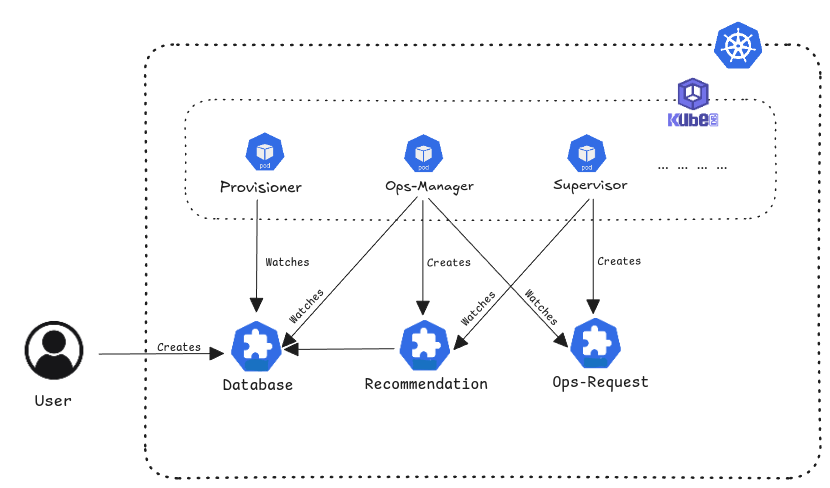
A Recommendation is a Kubernetes-native CRD created by the KubeDB Ops-Manager and reconciled by the KubeDB Supervisor. For an Elasticsearch cluster managed by KubeDB, the Ops-Manager watches the database’s state and emits a Recommendation whenever it detects an action you should take — a newer version, an expiring TLS certificate, or an authentication secret nearing its rotation deadline.
Nothing runs until the Recommendation is approved — either by you (status.approvalStatus: Approved) or automatically through an ApprovalPolicy bound to a MaintenanceWindow. Once approved, the Supervisor creates the corresponding ElasticsearchOpsRequest and tracks it to completion.
This page is the Elasticsearch-specific intro: which recommendations apply to Elasticsearch and which spec fields trigger them. For prerequisites, Helm flags that control generation timing, and the full Recommendation lifecycle, see:
- Recommendation Configuration — prerequisites, Supervisor CRD install, and all Helm flags.
- Recommendation Overview — architecture and lifecycle walkthrough.
Relevant KubeDB concepts
Recommendation types for Elasticsearch
| Type | Triggered when | Walkthrough |
|---|---|---|
| Version Update | A newer major, minor, or patch version becomes available | Version Update Recommendation |
| Same-Version Update | The container image for your current version is refreshed (e.g. security patch) | Version Update Recommendation |
| TLS Certificate Rotation | An issued certificate is approaching its expiry threshold | TLS Certificate Rotation Recommendation |
| Authentication Secret Rotation | The auth secret is approaching its rotateAfter deadline | Authentication Secret Rotation Recommendation |
Triggers specific to Elasticsearch
This section shows the minimal Elasticsearch CR fields that cause each recommendation to be generated. For deeper, end-to-end walkthroughs use the links in the table above.
Authentication Secret Rotation
apiVersion: kubedb.com/v1
kind: Elasticsearch
metadata:
  name: es-recommendation
  namespace: demo
spec:
  version: xpack-9.1.9
  authSecret:
    kind: Secret
    name: es-auth
    rotateAfter: 1h
In this configuration:
- The
rotateAfterfield defines how long the authentication secret remains valid
KubeDB monitors the configured lifecycle and generates a RotateAuth Recommendation based on the following conditions:
If the secret lifespan is greater than one month, a recommendation is generated when less than one month of validity remains
If the secret lifespan is less than one month, a recommendation is generated when approximately one-third of its validity remains
Once approved, KubeDB creates an opsrequest to rotate the credentials automatically, ensuring:
No expired credentials
Improved security posture
Reduced manual intervention
TLS Certificate Rotation
apiVersion: kubedb.com/v1
kind: Elasticsearch
metadata:
  name: es-recommendation
  namespace: demo
spec:
  version: xpack-9.1.9
  enableSSL: true
  tls:
    issuerRef:
      apiGroup: cert-manager.io
      kind: Issuer
      name: es-issuer
    certificates:
      - alias: client
        duration: 1h20m
      - alias: http
        duration: 2h10m
In this configuration:
- The
spec.tls.certificates.durationfield defines how long each certificate remains valid
KubeDB monitors the configured lifecycle and generates a RotateTLS Recommendation based on the following conditions:
If the certificate duration is greater than one month, a recommendation is generated when less than one month of validity remains
If the certificate duration is less than one month, a recommendation is generated when approximately one-third of its validity remains
Once approved, KubeDB creates an opsrequest to reconfigure TLS automatically, ensuring:
Continuous secure communication
No unexpected certificate expiry
Seamless certificate renewal
Version Update
apiVersion: kubedb.com/v1
kind: Elasticsearch
metadata:
  name: es-recommendation
  namespace: demo
spec:
  version: xpack-9.1.9
In this configuration:
- KubeDB monitors the running version of the database
KubeDB monitors the configured lifecycle and generates a VersionUpdate Recommendation based on the following conditions:
If a newer container image is available for the current version, a recommendation is generated
If a patch version is released, a recommendation is generated
If a newer minor or major version becomes available, a recommendation is generated
If changes are introduced in the existing version image (e.g., security fixes or image updates without a version bump), a recommendation is generated
For example: Recommending version update from xpack-9.1.9 to xpack-9.2.3
Once approved, KubeDB creates an opsrequest to perform the version upgrade automatically, ensuring:
Timely adoption of security patches and fixes
Access to new features and improvements
Consistent performance and stability across deployments
Same-Version Update
apiVersion: kubedb.com/v1
kind: Elasticsearch
metadata:
  name: es-recommendation
  namespace: demo
spec:
  version: xpack-9.1.9
In this configuration:
- KubeDB monitors the container image of the current database version
KubeDB monitors the configured lifecycle and generates a SameVersionUpdate Recommendation based on the following conditions:
- If the container image backing the current version is updated (e.g., security patches or rebuilds without a version change), a recommendation is generated
Once approved, KubeDB creates an opsrequest to update the running workload automatically, ensuring:
Security patches are applied without requiring a version upgrade
Consistency with the latest available container image
Improved reliability and maintainability
For prerequisites, Helm configuration flags, and the full cross-database Recommendation lifecycle, see the Recommendation Configuration and Recommendation Overview in the operator manual.